



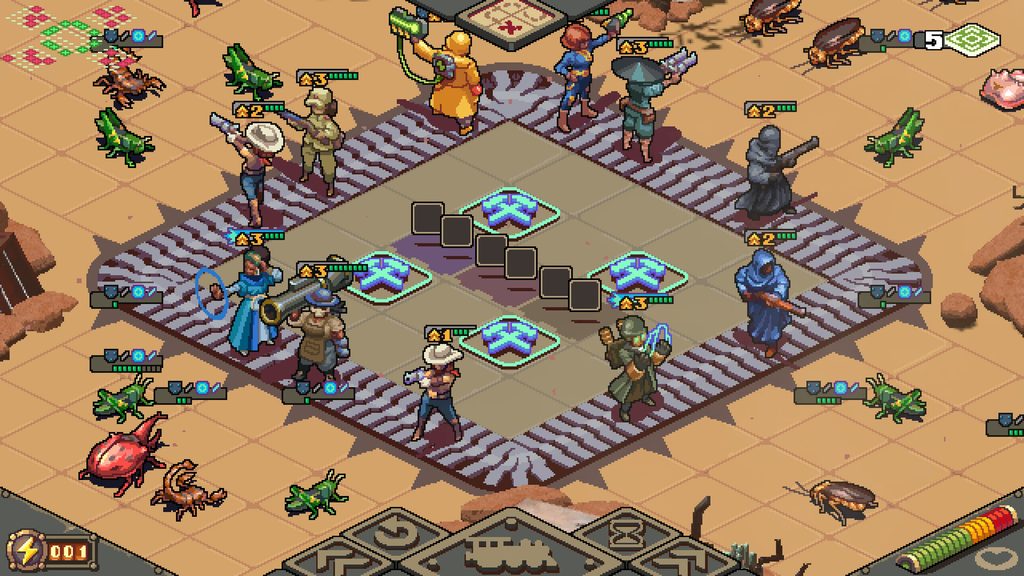
Image above: Australia Did It: End-of-the-World Railway Defense Business, co-developed by Rami Ismail and Aesthetician Labs.
In his TEDx talk, Vusi Thembekwayo, a South African entrepreneur, venture capitalist, and international business speaker, describes a familiar startup: the founder who meets a client on Monday, sells them a service on Tuesday, delivers the work on Wednesday, sends an invoice on Thursday, and chases payment on Friday so they can pay their landlord. “The only resource you have as an entrepreneur to compete with big businesses is that you can move faster than they can,” he says. So, the founder is responsible for every part of the value chain, but what happens when they get sick, need a break or simply cannot do everything anymore? The answer isn’t necessarily to build a massive organisation. It is to build a team that takes ownership and solves problems.
When discussing the qualities she looks for when hiring, Adaora Mbelu, also known as Lumina, a Nigerian creative strategist and entrepreneur, explains: “I look for people who are entrepreneurial, not necessarily that you are trying to start a business, but that you are a person who is a problem solver. You think like an entrepreneur. You think I want to solve this problem. This task I am being given is solving something, and that’s why I am dedicating myself to make sure that this thing gets solved. If you have people who think like that, it’s easier for them to take initiative on things. You don’t have to explain to them how something needs to be done; they care so much about getting it done that they’ll figure out how to do it.”
A small team of people who take initiative and solve problems can accomplish far more than its headcount might suggest. And nowhere is this possibility more exciting than in game development.
A small game can make a big difference
We often measure video games by commercial success, technological breakthroughs, or their ability to educate and solve specific problems. But entertainment has value in its own right. Games help people unwind, connect with friends, explore new worlds, and have fun. A review of 28 studies published in the Journal of Medical Internet Research (JMIR) found evidence that commercial video games can help reduce stress and anxiety.
I experienced the wider value of games as a teenager when I used Mavis Beacon to learn touch typing. What felt like playing a series of games helped me develop a practical skill that continues to serve me as a professional writer. A game can teach a skill, introduce someone to a community, or offer a moment of joy during a difficult period. Developers may never know the full extent of that impact.
And they don’t necessarily need a hundred-person team to create it. A small game made by fewer than ten people can reach thousands of players, with experiences that ripple into their relationships, workplaces and communities. AI-assisted tools can also help some small teams streamline their workflows, potentially giving them more time and financial runway to focus on making games. The ambition can be enormous, even when the team is tiny.
Team growth is not the goal
At Gamescom 2026, I attended a session that challenged the assumption that successful game studios must eventually become large organisations. The session was presented by Aesthetician Labs, a three-person, worker-owned cooperative based in New York. Noah Magnolia, Aidan Markham, and Sam Magnolia have worked together for eight years, combining client work and co-development with their own intellectual property.
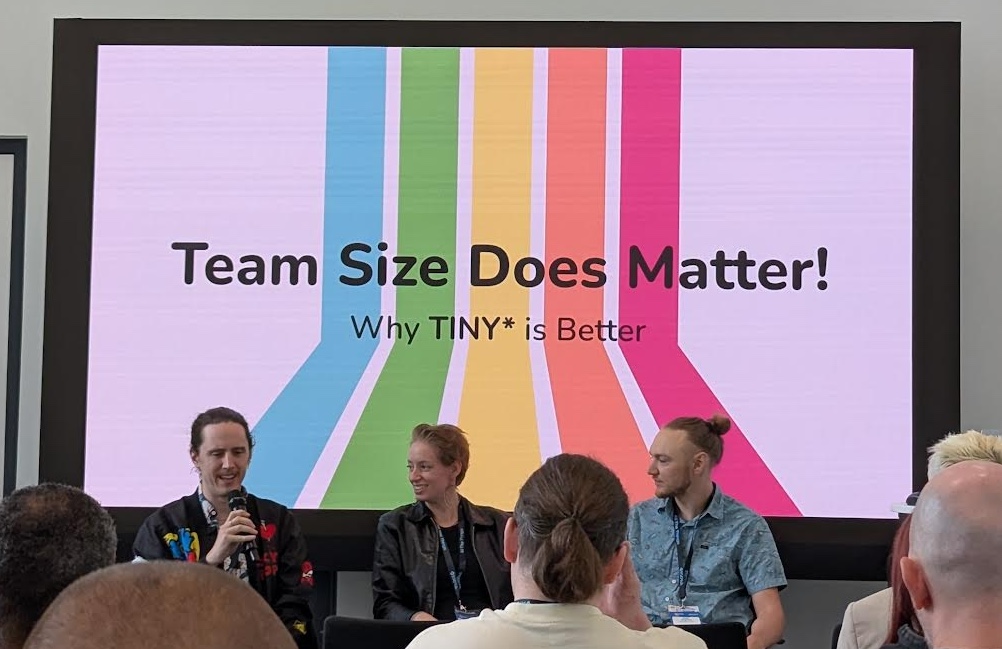
After starting with hypercasual projects, they pivoted towards PC and console games. Their experience has taught them to adapt as market trends, opportunities, and creative interests change. They advocate for intentionally tiny teams of ten people or fewer, drawing on their own experience rather than theory. During the session, Sam described the studio’s approach as follows: “Folks have complimented us in the past for being reliable and structured in the way that you would like big teams to be but still being experimental, nimble and flexible, which is one of the big advantages about small teams.” The goal isn’t to limit ambition. It is to build a studio that can pursue its ambition sustainably.
Six reasons to consider staying small
1. Faster
Think about your LinkedIn connections. As your network grows, the number of possible relationships between people grows much faster than the number of people themselves. The same applies to teams. A three-person team has three possible colleague-to-colleague relationships; a five-person team has ten. More people can bring more expertise, but they can also increase the coordination required to keep everyone aligned. Smaller teams can often make decisions faster, spend less time in meetings, and devote more time to making the game.
2. More nimble
Aesthetician Labs compared a small studio to a Jet Ski and a large organisation to an oil tanker. The tanker carries more, but takes longer to change direction. The Jet Ski has less capacity, but turns quickly. In an unpredictable industry, small teams can respond to changing player preferences, platforms, funding, and creative opportunities without navigating multiple management layers. Sam also cautioned against becoming so focused on how a studio operates that it loses sight of its primary purpose: making games. The game earns the money that keeps the studio alive.
3. Cheaper
Aesthetician Labs explained that approximately 80% of its studio budget goes towards paying its team reasonable wages. Adding another person can significantly change how long the studio can sustain itself. Consider a simplified example: a studio with a $1 million budget hires ten developers earning $100,000 annually. Their salaries alone consume the entire budget in a year, before other expenses. A three-person team working with the same salary assumption would have considerably more money available for overheads and future development. This isn’t an argument for underpaying developers. It’s about understanding the true cost of hiring and recognising that a lower burn rate can buy a studio more time.
4. More generalising
In a small studio, people can wear multiple hats. When one task becomes frustrating, a team member may be able to switch to another responsibility where their skills or energy are better suited. That flexibility can also help developers stay connected to different parts of the creative process rather than becoming confined to a narrow role.
5. More skin in the game
When you’re one of three people building a game, your contribution is difficult to miss. You’re close to the whole project, and your decisions can visibly shape the finished product. On larger teams, developers may contribute to only a small part of a game, with little control over what ultimately makes it to launch. Smaller teams can foster stronger ownership, a more distinct creative identity, and more room to explore unconventional ideas.
6. Stronger team culture
In a small team, everyone helps shape the working environment. There are fewer layers between the people experiencing a problem and those who can address it. Small teams aren’t automatically healthy; poor communication, conflict, and burnout can happen anywhere. But a close-knit team can make it easier to discuss problems directly, take responsibility, and agree on solutions without getting lost in bureaucracy. The advantage isn’t simply having fewer employees. It’s having people who care about the work and how they work together.

Build for longevity
When a successful launch, funding round, or lucrative contract brings in money, the temptation is to hire, expand and increase monthly expenses. Aesthetician Labs encourages developers to resist scaling automatically. Instead, studios can use additional capital to extend their runway, experiment with ideas, and make more games. Growth isn’t inherently bad. Some projects require larger teams, and some studios have ambitions that demand more capacity. The question is whether adding people creates enough value to justify the additional cost and complexity.
Don’t scale because you can. Scale because the work requires it.
Staying small doesn’t mean working alone. Studios can collaborate with freelancers, co-development partners, publishers, and other studios, bringing in specialised expertise when needed without maintaining a large permanent team. For African game developers, this offers an opportunity to build globally connected studios that focus on their strengths, collaborate across borders, and expand their capacity when opportunities demand it.
But sustainability also means thinking beyond the next release. During the session, an audience member asked what happens when founders eventually want to retire. Ownership, succession, profit-sharing, and the departure of key team members all matter when building a business designed to last. Therefore, think ambitiously about what you want to create. Be deliberate about the size and structure of the business you build. And more importantly, treat yourself with self-compassion when things get tough.
As Patrick Moran, Co-Founder of Look North World, an independent virtual-world game studio and publisher, noted in his reflection on studio ownership: “Self-compassion is not softness; it is stamina. The research on it is boringly consistent: people who treat their own failures with the same steadiness they would offer a friend recover faster and quit less.”

A note from Gamescom
This article grew out of my Gamescom 2026 documentation, where I interviewed more than 30 industry stakeholders from 12+ countries.

My Gamescom journey was supported by the Africa–Europe Partnerships for Culture: Audio-visual programme, funded by the European Union, with co-funding from GIZ and the French Ministry of Foreign Affairs, jointly implemented by GIZ and Expertise France in a Team Europe approach.
Special thanks to Linda, Victor, Emmanuel, Mary and Débora for their support, guidance and encouragement throughout this journey.