

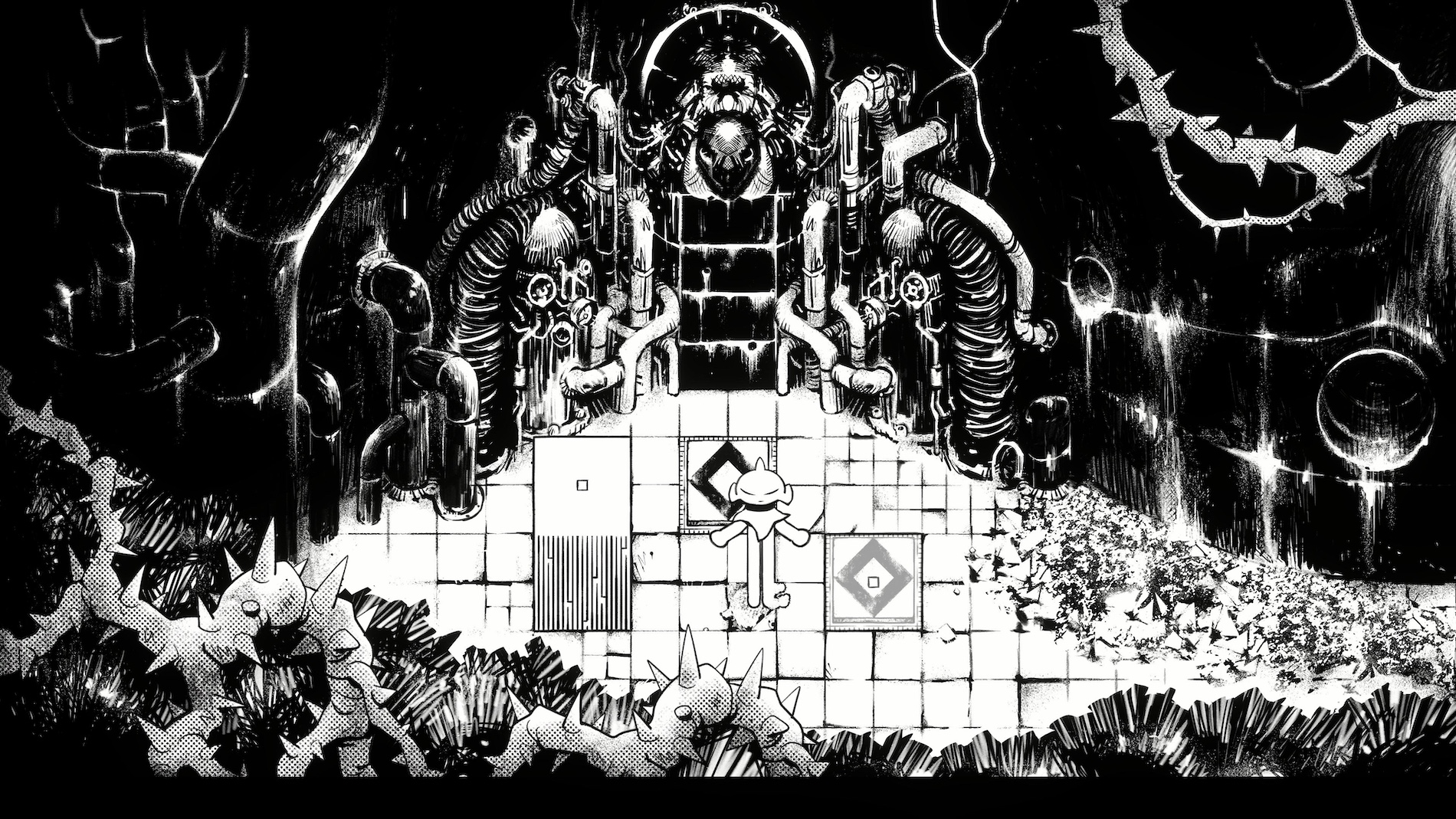

While attempting to stand out from the ever-growing crowd, games have a tendency to go bigger and louder, with more detail and more color. Helix: Descent N Ascend takes a notably different approach. Developed by Belgian indie studio Badass Mongoose, the puzzle-adventure builds its identity around a striking black-and-white visual language. One that is not only aesthetic, but structural to the game’s design.
According to the developers, the decision to choose a monochrome design was made for two reasons. “We wanted the game to stand out from the vast array of titles released every month. But also, we wanted to pay tribute to the comic books we cherish,” says lead artist Cedric De Muelenaere. He references influences such as GUNNM (Battle Angel Alita), TMNT (Mirage era), and Metal Hurlant (French edition). But to describe the unique black-and-white visuals as a purely aesthetic choice would be selling the game woefully short. They have become an integral part of the gameplay.
In Helix: Descent N Ascend, a lone being awakens in a monochrome world, learning it is the last of its kind, with only one path forward: move ahead, solve puzzles and uncover the truth. Progression comes through exploration and experimentation, as players unlock and combine abilities to interact with the environment in new ways. Light and darkness shape the world, constantly shifting spaces between open and closed states. There is no combat or dialogue, but instead an emphasis on discovery and systems to understand and master.Black & White
“Light and darkness function as an axiom in the game,” De Muelenaere explains. “While it is simple at first, it becomes more complex when ignored. As the game is black and white, light represents positive environments and darkness represents negative ones. Open spaces are opposed to closed ones. One ability allows the player to switch between positive and negative realms, therefore turning open-air areas negative and closed environments positive.” This binary framework creates a system where visual language, mechanics and spatial design are closely interlinked. “We would argue that all aspects of the game, the visuals, the levels and the general game design, are in dialogue with each other.”
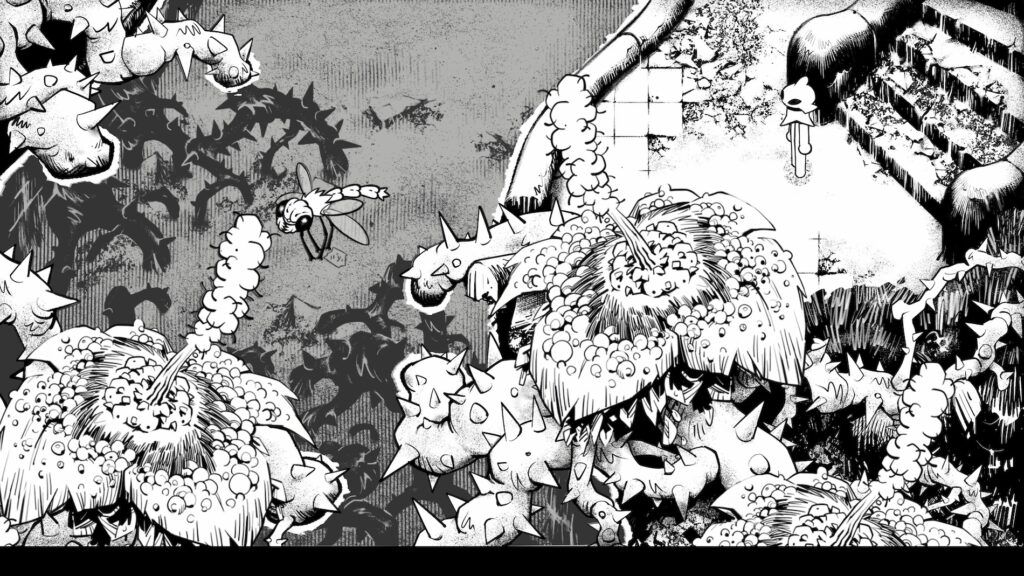
Helix is built around non-violent puzzle-solving and exploration, with players acquiring and combining abilities to progress. One of the team’s key technical and design achievements lies in how these abilities interact. “You can literally combine your abilities together, and not only use them separately at the same time,” says De Muelenaere. Ensuring that these combinations worked as intended required extensive iteration. “It wasn’t easy to come up with, nor to make sure that it wouldn’t break the game.”
Big puzzle
The team’s design process combines conceptual thinking with rapid iteration. “First, we talk and sketch. We brainstorm and theorise about how something would work. Then we try it in the game and iterate.” Early playtesting played a critical role, particularly in addressing difficulty. Initial versions were, by the team’s own admission, overly punishing. “There was almost no learning curve, so people had no idea what to do or where to go… It was brutal!” De Muelenaere says. Feedback helped recalibrate the experience into something still demanding, but more accessible.
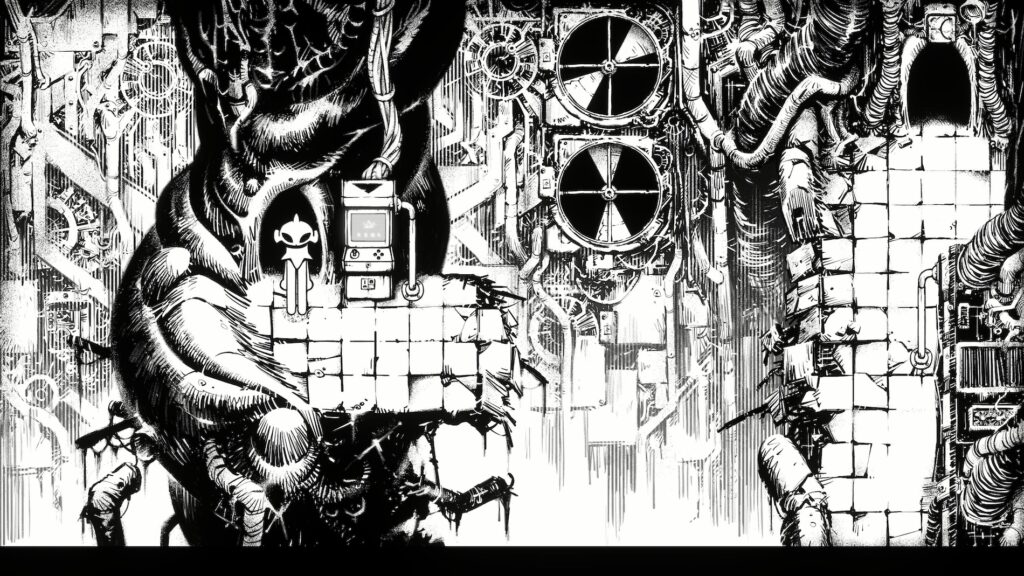
The origins of Helix date back seven years, long before production formally began. “First, we wanted a game with no text so that we wouldn’t have to localise it. Then, we didn’t want to have combat in it, so we wouldn’t have to animate all the enemies,” De Muelenaere says. These cost-driven decisions eventually evolved into a guiding design philosophy. “It might sound silly when we say we wanted to save money… but we believe that these restrictions encourage more creativity in game design. It turns the process of making the game into our own big puzzle.”
Early soundtrack
Founded four years ago in Courcelles, in the French-speaking part of Belgium, Badass Mongoose consists of just two core members: developer Gillian Sampont and lead artist Cedric De Muelenaere. “So, we’re one developer and one artist who also work together on game design, level design and story development,” explains De Muelenaere. While the duo does most of the work in-house, external collaborators are brought in selectively. “For example, we work with a talented animator for the main characters and animals, as well as for most of the visual effects. We also outsource sound effects and music.”
The soundtrack is composed by Jim Guthrie, known for his work on Nobody Saves the World and Sword & Sworcery. It was integrated unusually early in development. “We got in touch with him with a few sketches and a pitch, and he said ‘OK’,” De Muelenaere recalls. “We were barely anywhere in the project, but we wanted to know as soon as possible.” This early collaboration influenced the creative process directly. “I spent all the time sketching whilst listening to his tracks on repeat,” he says, smiling.
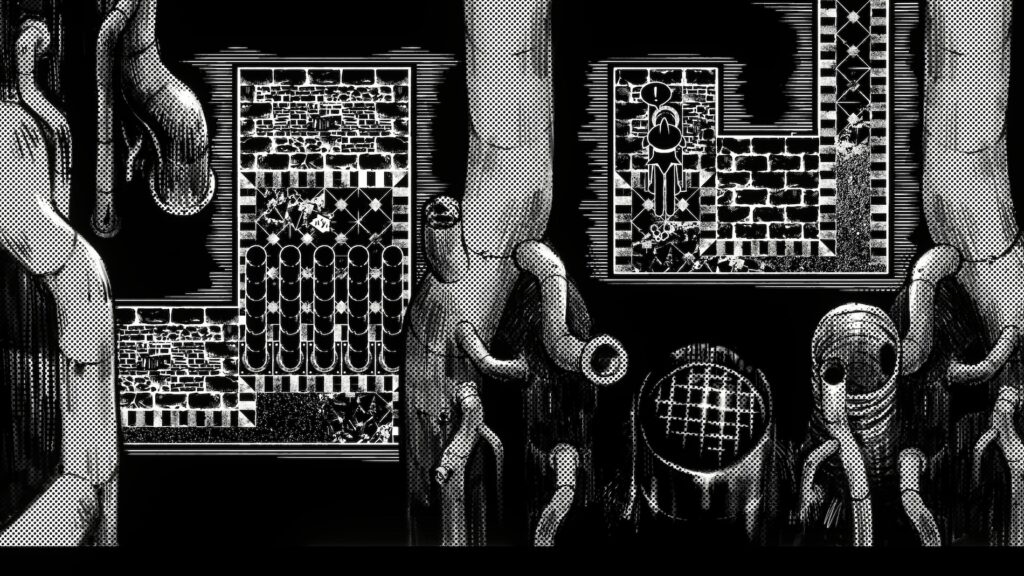
Now, seven years after the initial idea and five years of development, the game is ready to be released. Looking back on the 5-year development, De Muelenaere is mild. “While it would be tempting to say ‘we should have made a smaller game’, we’re so proud of what we came up with that it wouldn’t be fair,” he says. “More accurately, the lesson for us is to apply everything we’ve learned from this project, in all of its aspects, to the next one. Always with love and dedication.”
Helix: Descend N Ascend is out on PC and Nintendo Switch on 23 July 2026